
Ardgowan Distillery, Scotland
a Cathedral to Whisky
Set within the Ardgowan Estate at Inverkip, the new Ardgowan Distillery brings together ambitious whisky production, visitor experience and striking steel architecture. Designed as a landmark building in an exposed countryside setting, the project shows how hot dip galvanizing can provide both architectural expression and long-term protection for fully exposed structural steelwork.
“With all structural steelwork left exposed, hot dip galvanizing delivered the durability, finish and long term protection needed for a landmark distillery designed to perform both technically and architecturally.”
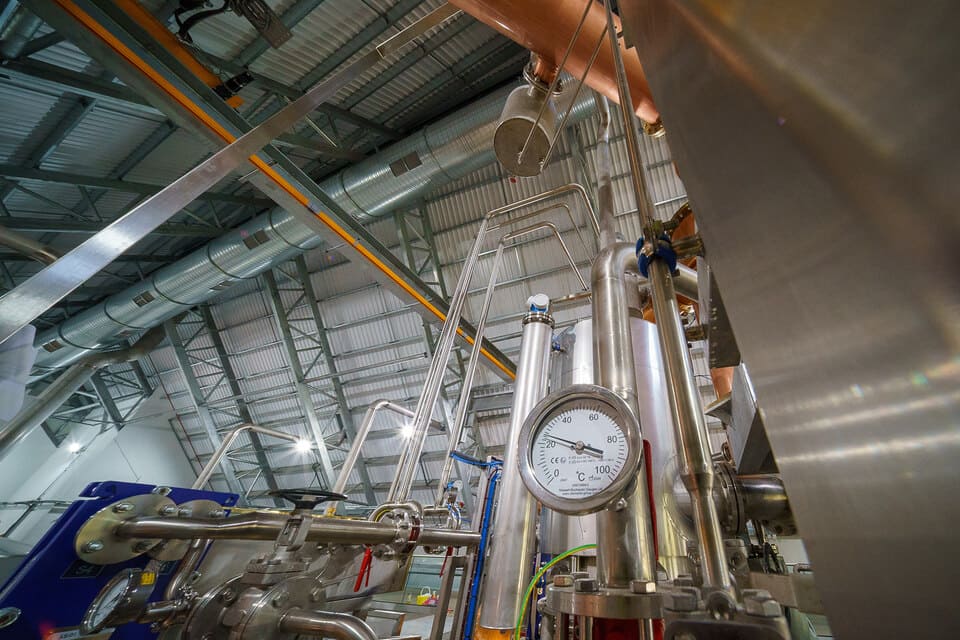
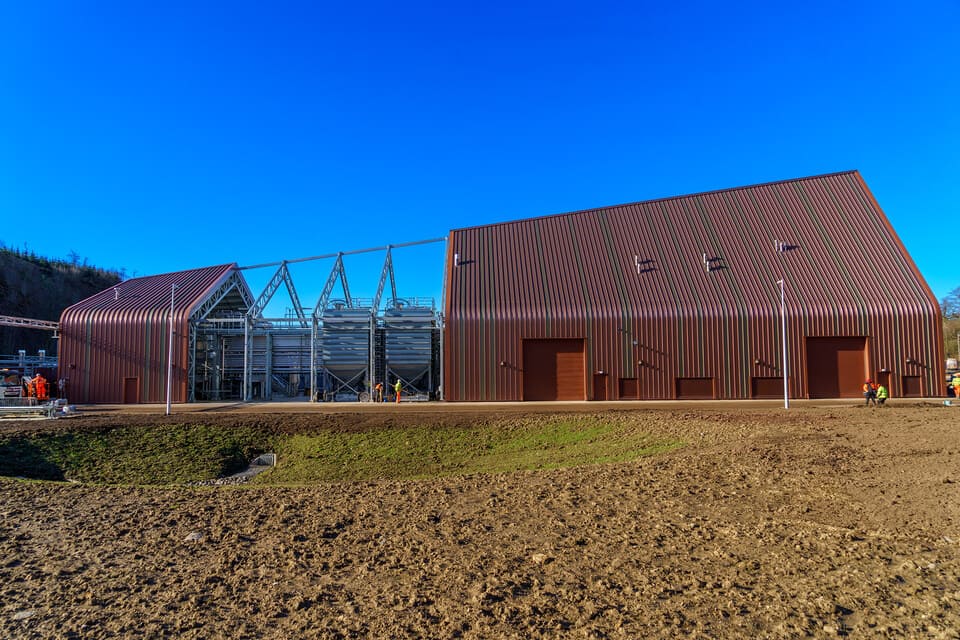
After centuries of fluctuation, whisky production in Scotland is once again enjoying a remarkable high point. More than 30 new distilleries have opened in the past decade, reflecting substantial growth in the sector and growing demand both internationally and at home. Against this backdrop, a major new distillery and visitor destination has been completed on the Ardgowan Estate, near Greenock, 30 miles west of Glasgow.
Conceived as a world-class production facility and visitor attraction, Ardgowan Distillery has been designed to tap into the buoyant market for premium malt whisky while also bringing economic and social benefit to Inverclyde. The distillery has the capacity to produce up to two million litres of whisky a year
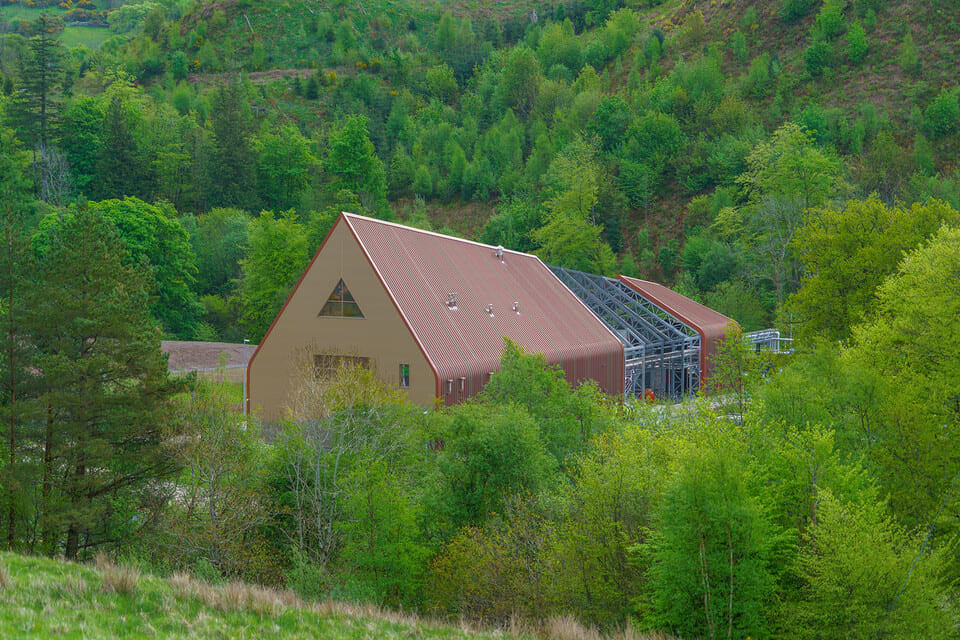
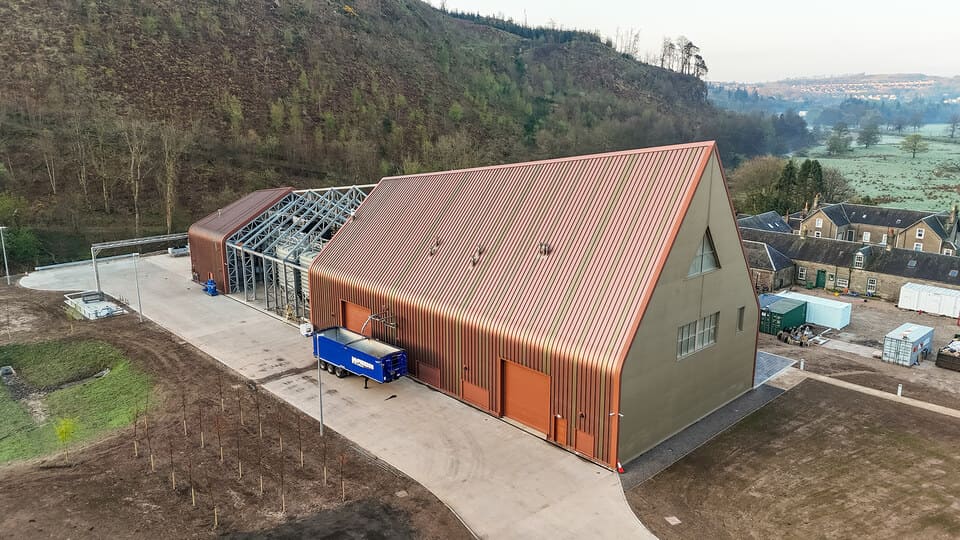
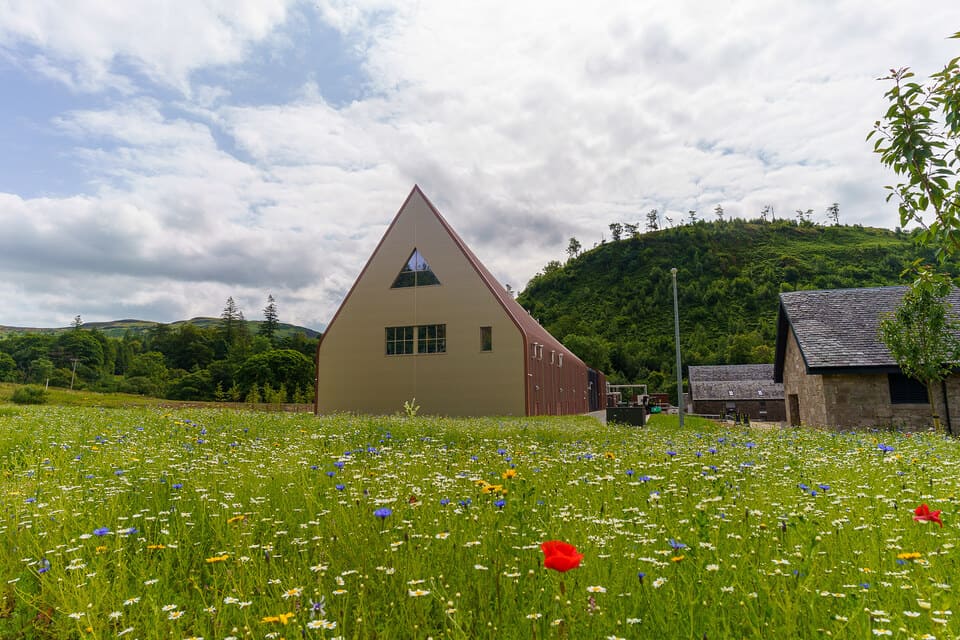
Architecturally, the building is designed to make an immediate impression. Its steeply sloping pitched roof and tall steel-framed form give it a powerful silhouette, one that has already been likened to a church or even a cathedral to whisky. Set within a valley clearing and surrounded by wooded hillsides, the distillery has been conceived as both an industrial building and a landmark in the landscape.
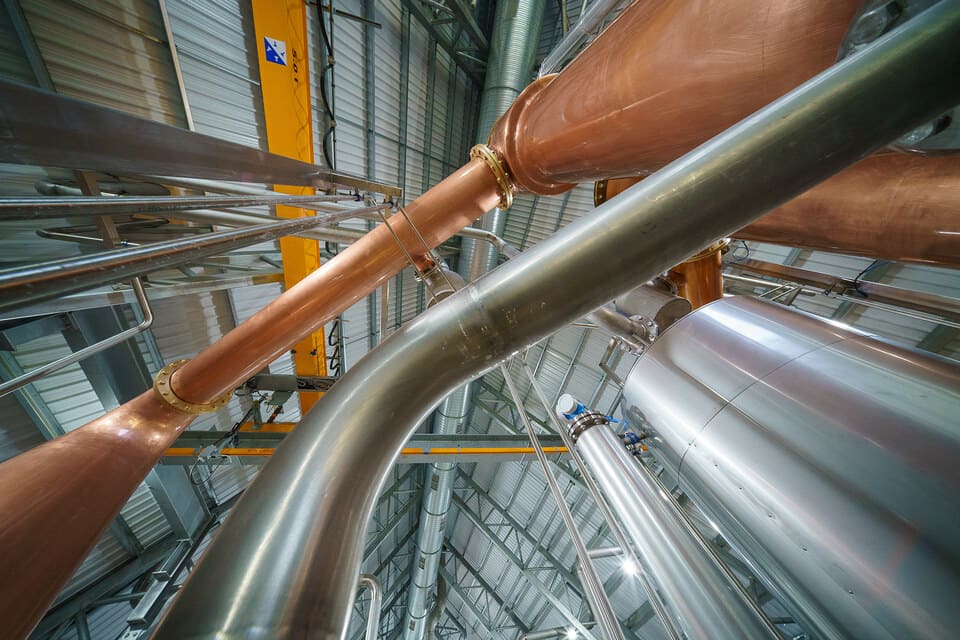
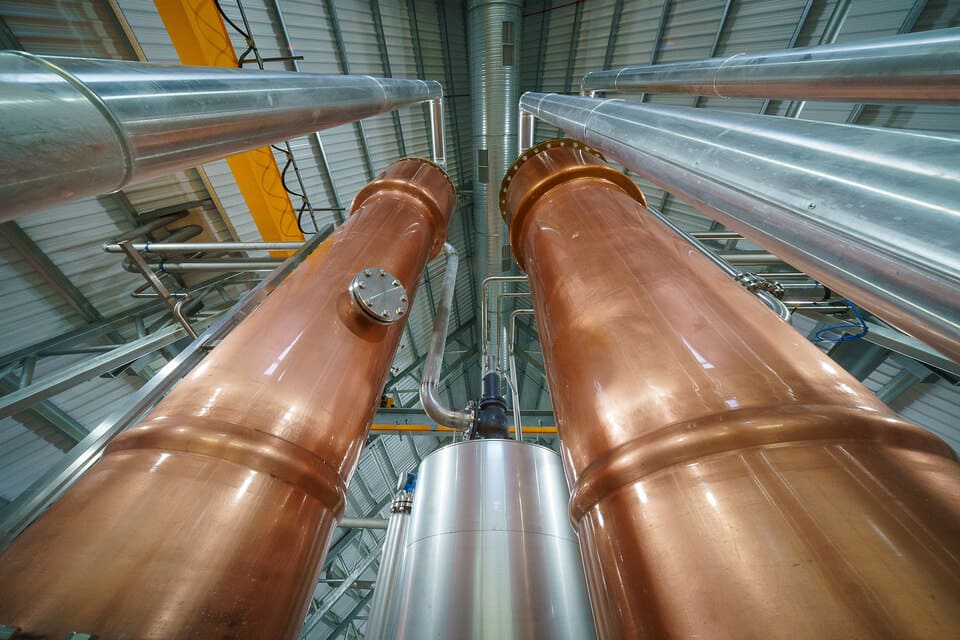
The steep roof creates a light-filled internal environment while also providing the span needed to accommodate large-scale process equipment, including a five-tonne mash tun, fermenters and copper stills. The building’s proportions and structural form allow it to house substantial production capacity without compromising the clarity of the interior space.
Once complete, the external cladding will feature copper-red and bronze tones, chosen to echo the autumnal hues of the surrounding estate. Yet it is the structural steel frame, fully exposed within the building, that provides the project with much of its architectural character.
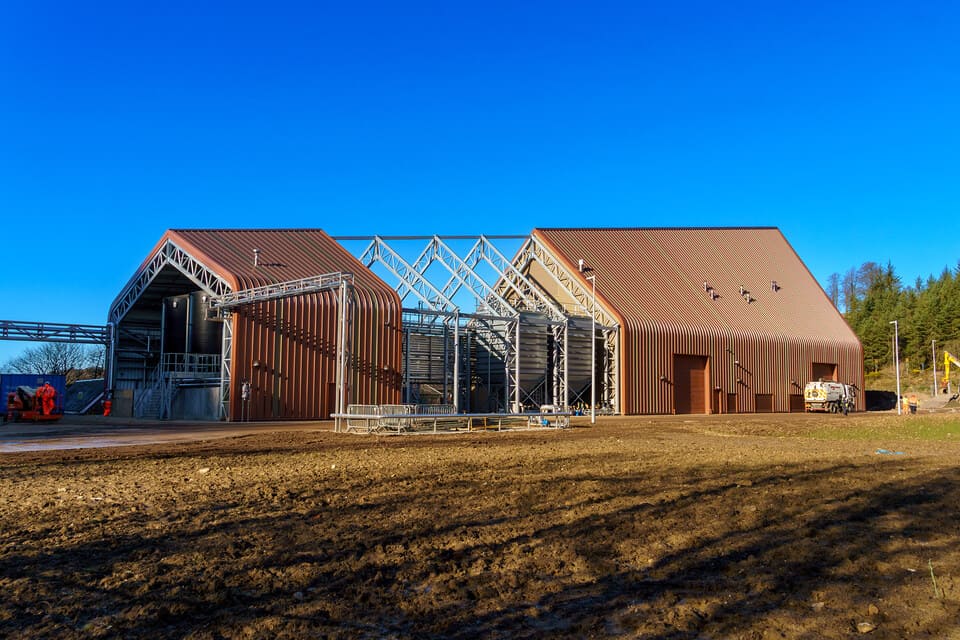
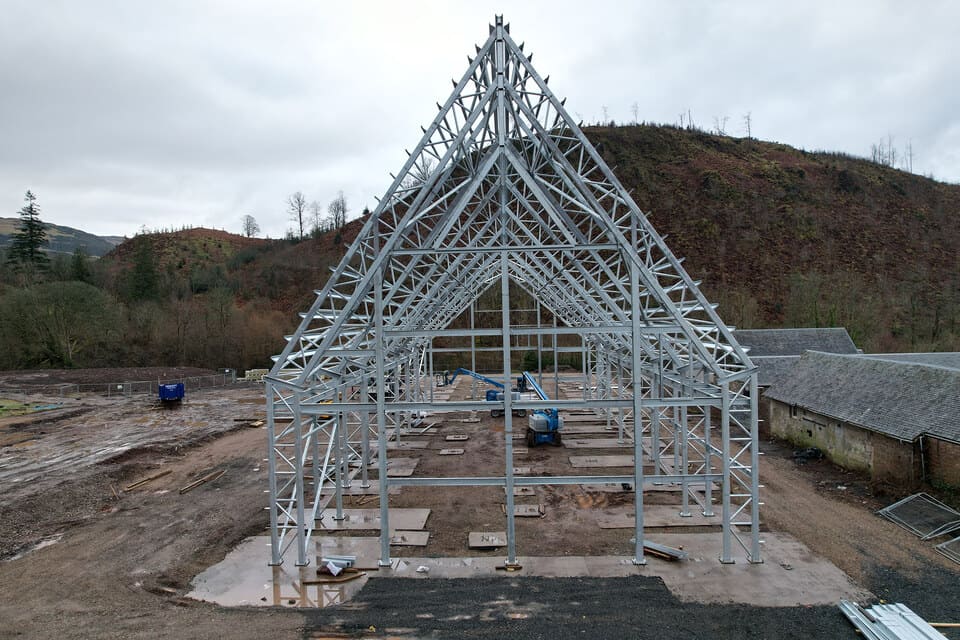
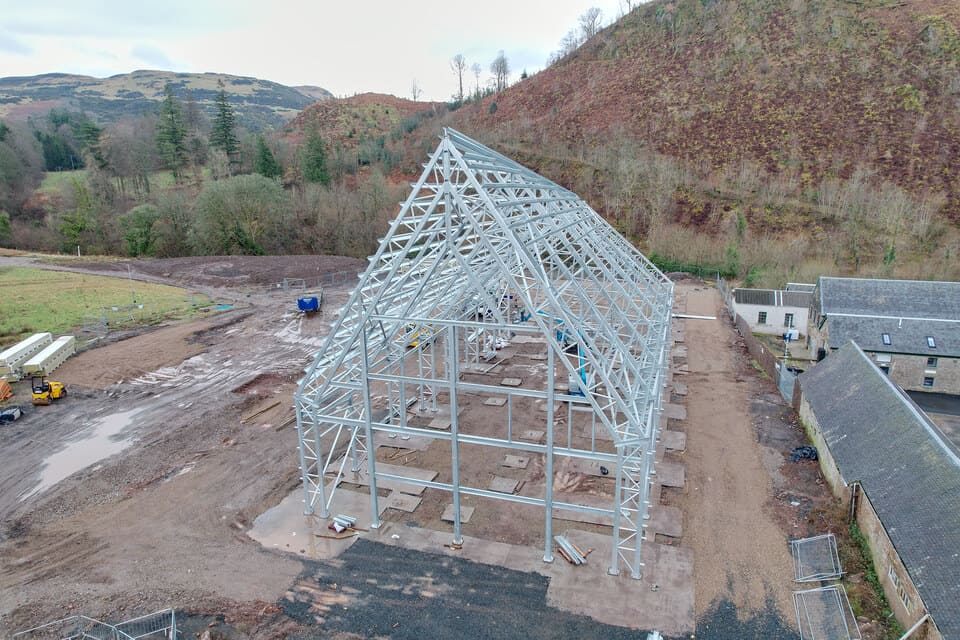
The primary frame departs from the more familiar rolled-section portal frame solution often used for industrial buildings. Instead, Ardgowan Distillery adopts a trussed portal frame, giving the structure both the required strength and a more refined visual quality.
The perimeter columns are formed from fabricated trusses measuring 7.3m high and 1.35m deep. These trusses were selected not only because they provide the rigidity needed to support the roof, but also because they were considered more visually appealing than conventional columns. At the head of each column truss, a crank point connects to a 1.35m-deep rafter truss that forms the pitched roof. This roofline slopes not only across the section but also along the length of the building, rising to 16.5m at its highest point and falling to 10m at its lowest.
Approximately 60m long, the building has been designed as a portal-framed structure divided into two main zones. The taller section houses the milling, mash house and still production areas, while the lower end accommodates tanks and silos. Two bays containing the principal silos remain unroofed, instead being covered with netting fabric to preserve the overall roof profile while leaving that part of the structure open to the elements.
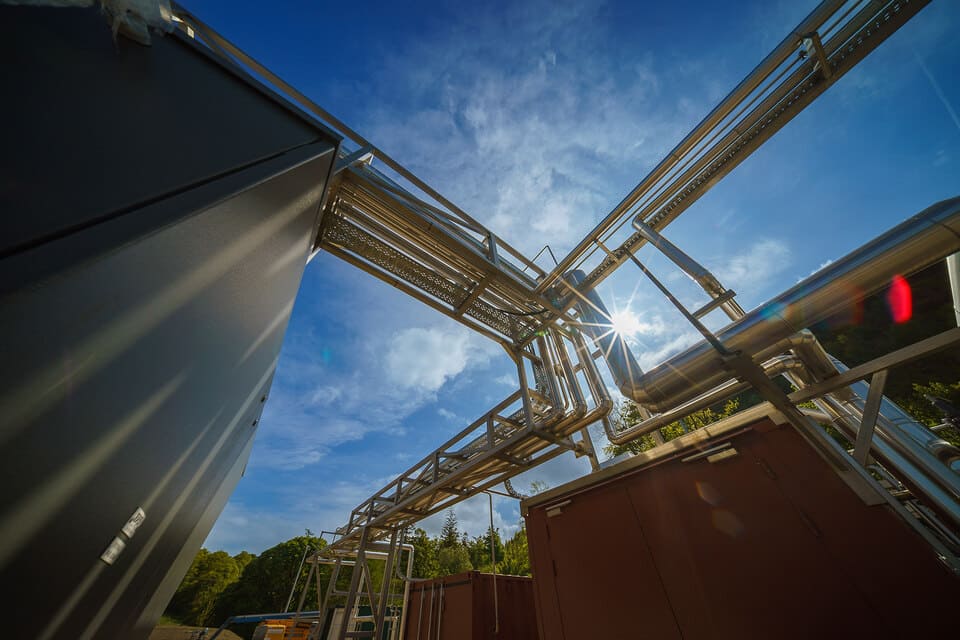
Because all of the steelwork is intended to remain exposed within the completed building, durability was a fundamental consideration from the outset. For that reason, all structural sections, including the trusses, were fully finished using hot dip galvanizing.
In a project of this kind, where exposed steelwork plays such a visible role in the architecture, the finish has to do more than simply protect the metal. It must also withstand handling, erection and the operating conditions of a demanding industrial environment. Hot dip galvanizing offered that combination of resilience and finish quality, providing the steel frame with the long-term protection required while also supporting the visual ambitions of the design.
The decision to use galvanized steel was especially appropriate given the building’s location on an open estate site and the need for robust performance over time. In this exposed environment, the structural frame had to offer reliability from the earliest stages of construction through to long-term operation. Leaving the frame visible within the final building only heightened the importance of choosing a finish capable of delivering lasting protection without reliance on more vulnerable surface coatings.
All of the column and rafter trusses were delivered to site as fully welded elements, ready for erection. Working for main contractor Muir Construction, Hescott Engineering completed erection of the main frame using a single 60-tonne mobile crane. Before the steelwork programme began, the previous sawmill occupying the site had been demolished and pad foundations with base plates installed to receive the truss columns.
Following completion of the primary frame, the internal steelwork was installed. This includes two floor levels: an intermediate level 3 m above ground surrounding the processing tanks, and a main production floor 6 m above ground covering around half of the building footprint. The installation of this internal steelwork required close coordination with the placement of process equipment, with steelwork being erected around tanks and vessels as they were brought into position.
This relationship between structure and process is central to the project. The steel frame is not simply an enclosure but an active part of the building’s operation, supporting walkways, floors and a gantry crane that will be used for future maintenance and replacement of plant.
The distillery has also been planned with future operational needs in mind. Certain tanks and vessels will need to be replaced every ten to fifteen years, and to allow for this, demountable apertures have been incorporated into the steel-framed floors. These openings will enable lifting operations to be carried out using the gantry crane supported from the main frame.
This forward-thinking approach reflects the wider design ethos of the project: a building conceived not only for immediate use, but for efficient long-term operation. In that context, hot dip galvanizing again supports the wider objectives of durability, maintainability and long-term protection.
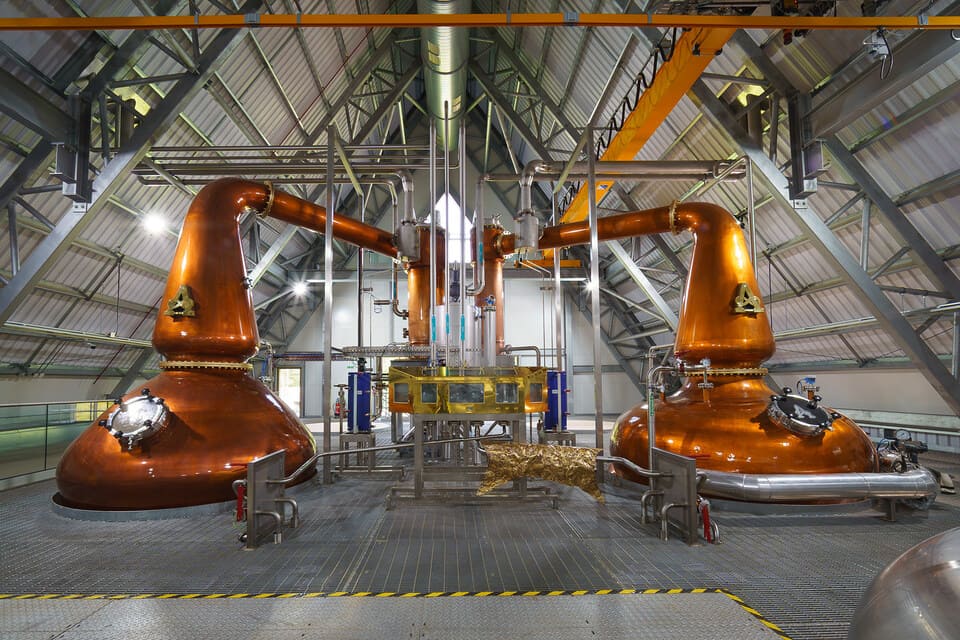
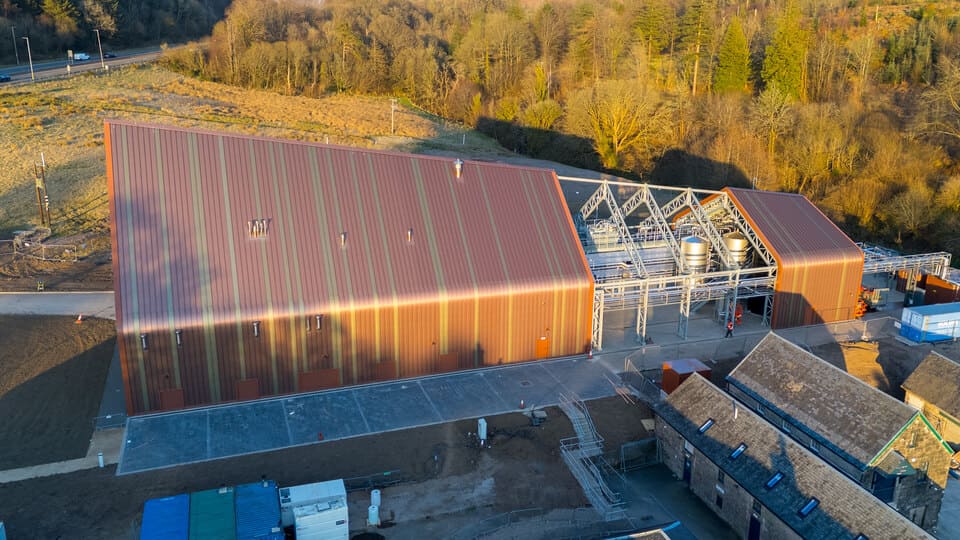
One of the project’s most notable engineering achievements came in the redesign of the roof steelwork. To realise the architect’s vision of a smooth, seamless roof plane sloping in two directions, the original roof support arrangement was reworked. Circular hollow section members were replaced with conventional purlins, connected to carefully positioned cleats that varied slightly throughout the structure.
By using torsionally flexible purlins to accommodate rotation, the design team was able to align the roof form with the architectural model. Because no software package was available to check the rails with the required twist, the calculations had to be undertaken by an independent engineer. The result was a more elegant and efficient design that also delivered cost savings for the client.
A second phase of the development is planned, comprising a steel-framed visitor centre adjoining the highest end of the distillery.
Together, the buildings will establish Ardgowan as both a production facility and a destination, helping to anchor the distillery within the wider estate and the local economy.
Even before that next phase is realised, the main distillery already stands as a powerful example of how structural steel can shape industrial architecture with clarity and ambition. Its church-like profile, exposed trusses and carefully resolved roof give the building a distinctive identity, while its engineering supports the practical demands of modern whisky production.
In this project, hot dip galvanizing plays a crucial role. It ensures the exposed steelwork can perform in a challenging setting, supports efficient fabrication and erection, and provides the long-term protection essential to a major production building. At Ardgowan Distillery, galvanizing is not a secondary specification choice; it is integral to the success, durability and character of the architecture.
Information provided by Hescott Engineering
Project Information
Hescott Engineering
© Chris Scott
© Martin McAdam
- UK & Ireland
- Clevedon, England
- UK & Ireland
- UK & Ireland
- Bochum, Germany
- Putbus, Germany
- Inverkip, Scotland
- Rhineland, Germany
- Belfast, Northern Ireland
- London