
Demountable Pavilion
Created for Belfast 2024, DRIFT is a demountable floating pavilion designed to bring public life onto the River Lagan through sound, movement and immersion. Developed as a reusable structure for an exposed river environment, the project demonstrates how hot dip galvanizing and carefully coordinated steel detailing can support adaptability, durability and long-term protection in low-impact civic architecture.
“By combining modular design with galvanised steel pontoons and bespoke bracketry, DRIFT shows how hot dip galvanizing can enable a floating pavilion that is robust, reconfigurable and built for long term protection.”
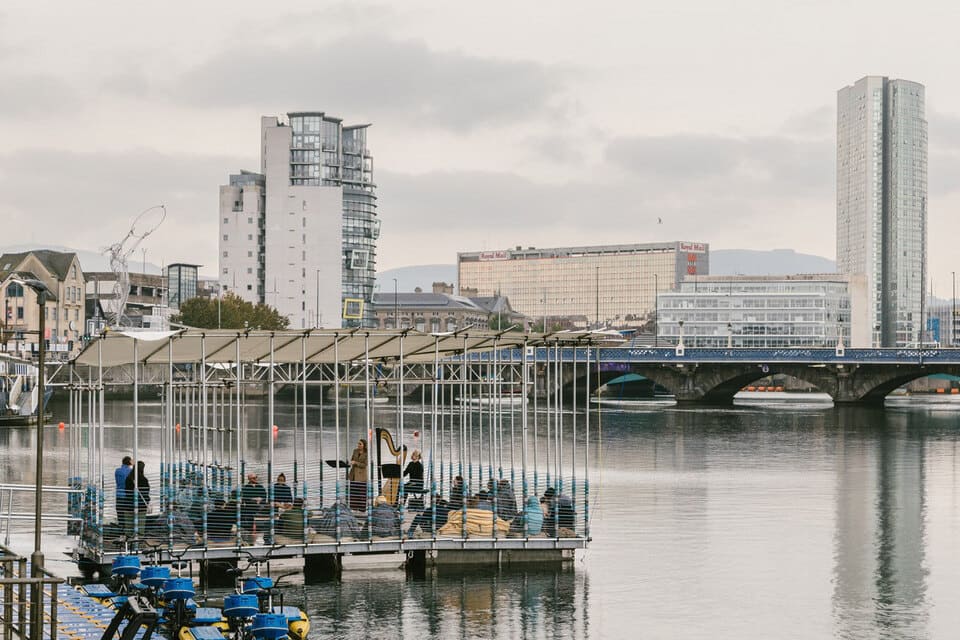
Public Space Reimagined on the River
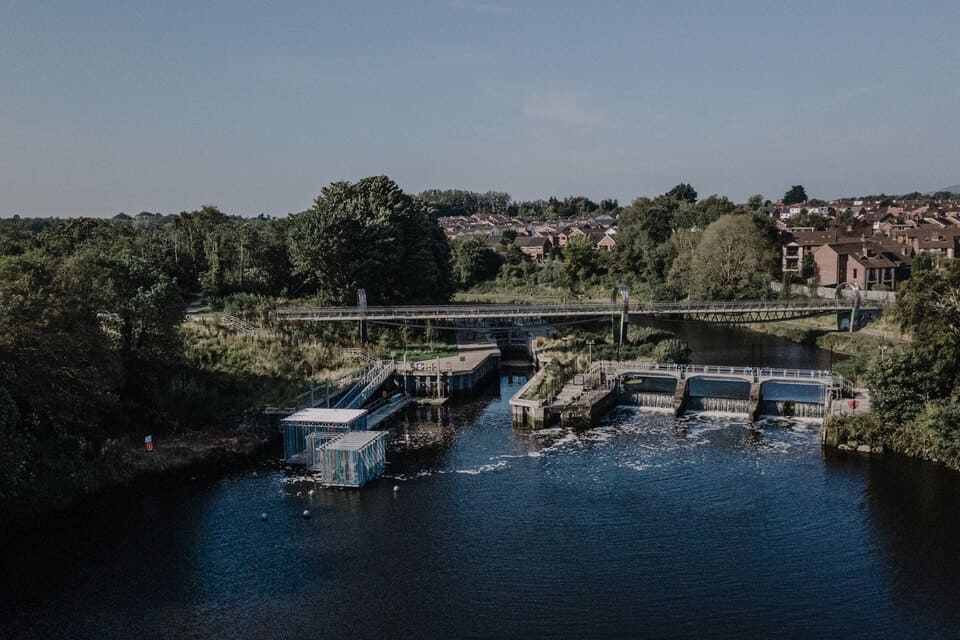
DRIFT was conceived as a new kind of public space for Belfast: a floating, demountable pavilion that could reconnect people with the River Lagan. Delivered as part of the Belfast 2024 programme, the project was designed to create an immersive civic experience on a stretch of urban river that is often visually present but physically inaccessible.
Rather than existing as a fixed object, DRIFT was imagined as a shapeshifting structure able to respond to different locations and conditions. Developed in collaboration with sound artist Matilde Meireles, the pavilion invited visitors to engage with the river through sound, movement and changing spatial relationships, offering a more sensory and direct encounter with the water.
The delivery model was as innovative as the design itself. To realise the project, the team established a dedicated company that assumed the roles of designer, contractor, client and operator. This hands-on approach allowed close control over design, fabrication and installation, while reinforcing the project’s emphasis on adaptability and long-term reuse.
A Floating Pavilion Designed for Change
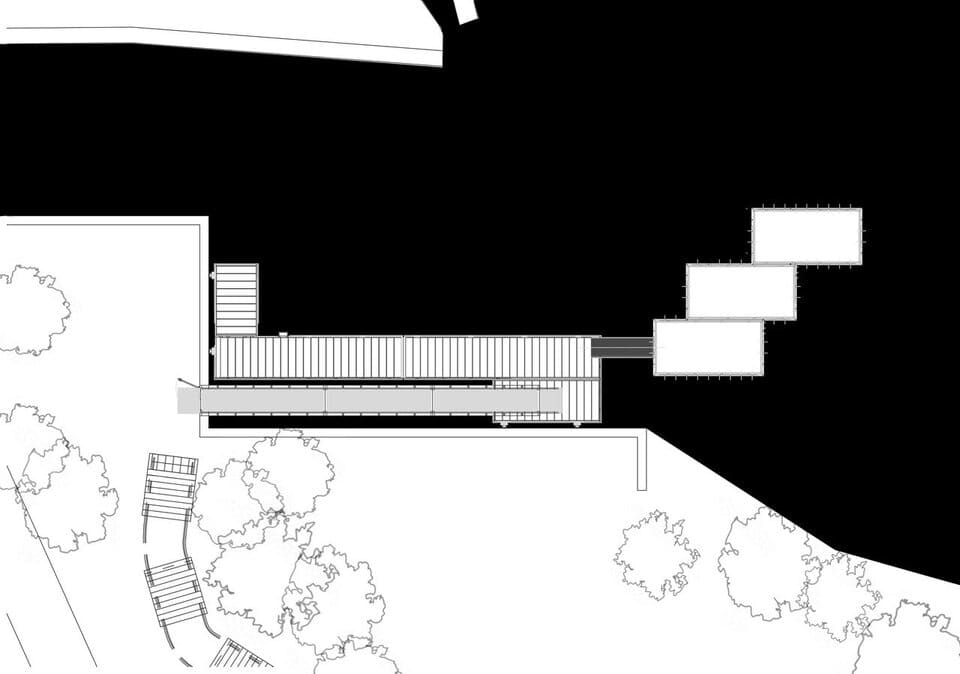
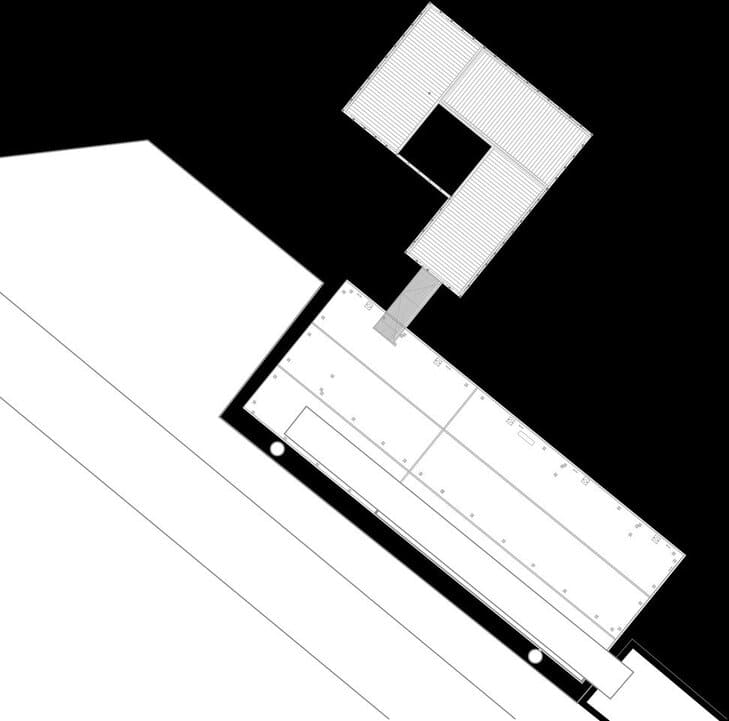
At the heart of DRIFT is the idea that architecture on water should be flexible rather than fixed. The pavilion was designed as a modular system capable of being assembled, dismantled and reconfigured into different forms depending on site and programme. That adaptability was central to its identity, allowing the structure to operate not as a one-off installation but as a reusable piece of public infrastructure.
This approach required a structural strategy that could accommodate change without sacrificing robustness. The solution lay in a carefully coordinated system of pontoons, scaffold superstructure and bespoke steel connections that together allowed the pavilion to be repeatedly installed and reassembled with minimal intervention.
In this respect, DRIFT is an important example of contemporary place-making in a constrained urban context. It shows how temporary architecture can still be designed for permanence of use, with components intended for multiple lives rather than a single event.

Why Galvanized Steel Was Essential
The success of that strategy depended heavily on material choice. Galvanized steel played a critical role in enabling the pavilion’s resilience, adaptability and longevity. Working with engineers Design ID and fabricators Inland & Coastal Marina Systems, the design team developed a bespoke galvanised steel edge bracket that allowed the floating pontoons and scaffold structure to connect securely while remaining easy to demount and reconfigure.
This detail was fundamental to the project. Without a durable and repeatable steel connection, the pavilion could not have achieved the flexibility that defined its concept. The use of galvanized steel ensured the structural elements could withstand the demands of an exposed riverine environment, reducing maintenance requirements and supporting the project’s circular, low-carbon ethos.
The floating pontoons themselves were also fabricated from galvanized steel, reinforcing the durability of the entire system. In a project where elements had to perform on the water, endure repeated assembly and disassembly, and remain suitable for future reuse, the value of hot dip galvanizing was clear. It provided the level of corrosion resistance and long-term protection needed for a structure designed not only to float, but to evolve.
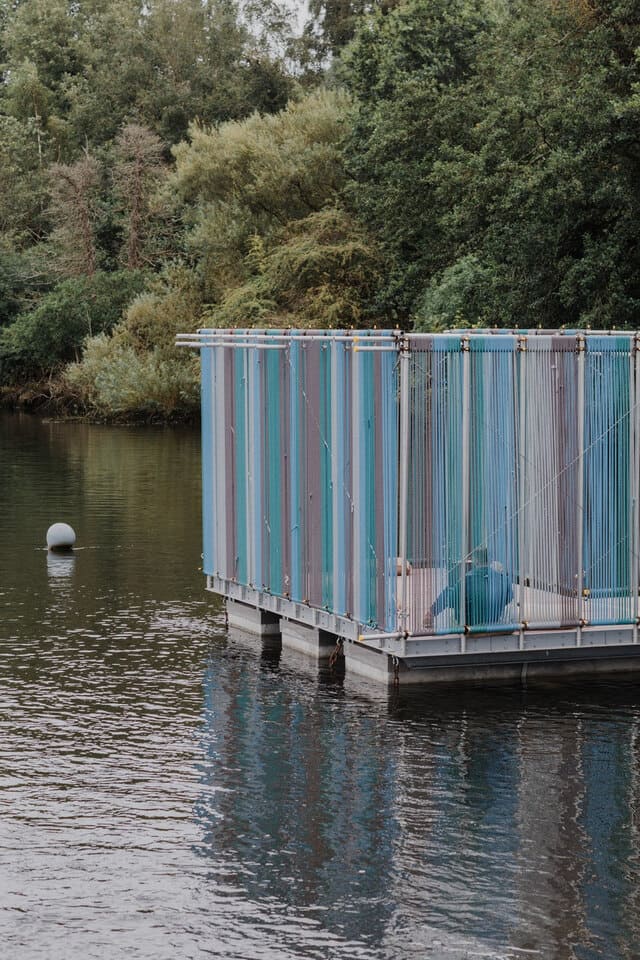

Precision in the Bracket Design
A key innovation within DRIFT was the design and fabrication of the bespoke galvanised bracket system linking the pontoons to the modular scaffold superstructure. This detail emerged through close collaboration between architect, engineer and fabricator, and demonstrates how relatively small components can have an outsized effect on the success of a project.
The bracket had to meet several competing requirements. It needed to support a variety of scaffold configurations, with one, two or three poles depending on location, while remaining based on a standardised and repeatable logic. It had to be easy to demount and refix, allowing the pavilion to be reinstalled multiple times without site-specific redesign. It also had to resolve corner conditions cleanly, balancing consistency across both linear and orthogonal connections.
Material efficiency was another priority. The edge support angle was carefully sized for strength, economy and ease of galvanizing, minimising both weight and waste while maintaining the robustness needed for repeated use.
At the same time, the scaffold poles had to sit cleanly within circular hollow section spigots without additional fixings or deformation that might compromise their structural behaviour.
The final detail used a galvanized steel angle section with a 33 mm diameter CHS insert welded through a CNC-machined hole. The CHS extended through the bottom flange of the angle and sat flush with the top, creating a reliable weld interface. An M12 fixing bolt passed through both bracket and scaffold pole, with pre-drilled holes positioned to ensure consistency during installation.
Two bracket options were reviewed during the design process: one with a cleaner flush interface and internal welds, and another with a visible CHS protrusion that improved welding access and eased bolt alignment with the scaffold upright. The latter was selected because it reduced site risk and simplified installation without compromising structural integrity.
That choice reflects the practical intelligence of the overall project. DRIFT was not simply designed to look refined; it was designed to work repeatedly and efficiently under real site conditions. The incorporation of tolerances into the detail, together with CNC hole placement and precise fabrication, helped balance manufacturing practicality with structural performance and visual clarity.
The coordination extended even to pontoon geometry. Inland & Coastal Marina Systems’ standard pontoon hole spacing was adapted to suit DRIFT’s 610-620 mm grid, allowing the pavilion to align with standard components without requiring the pontoons to be fundamentally re-engineered.
This careful adjustment transformed a standard product into a bespoke piece of demountable architecture.
DRIFT stands out not only as a cultural installation, but as an example of reusable architecture shaped by circular principles. Every aspect of the project, from the modular scaffold frame to the galvanized steel pontoons and brackets, was geared towards long-term reuse, low maintenance and reduced material waste.
Here, hot dip galvanizing supports more than corrosion resistance alone. It enables repeated assembly and disassembly without rapid degradation, helping preserve the value and performance of the structural components over time. In an exposed environment where water, weather and handling all place demands on the material, this level of resilience is essential.
By combining standardised galvanized components with bespoke detailing, DRIFT demonstrates how temporary public architecture can be both technically robust and environmentally responsible.
It suggests a replicable model for future floating interventions in cities, where access to water is often limited but the desire for civic connection is strong.
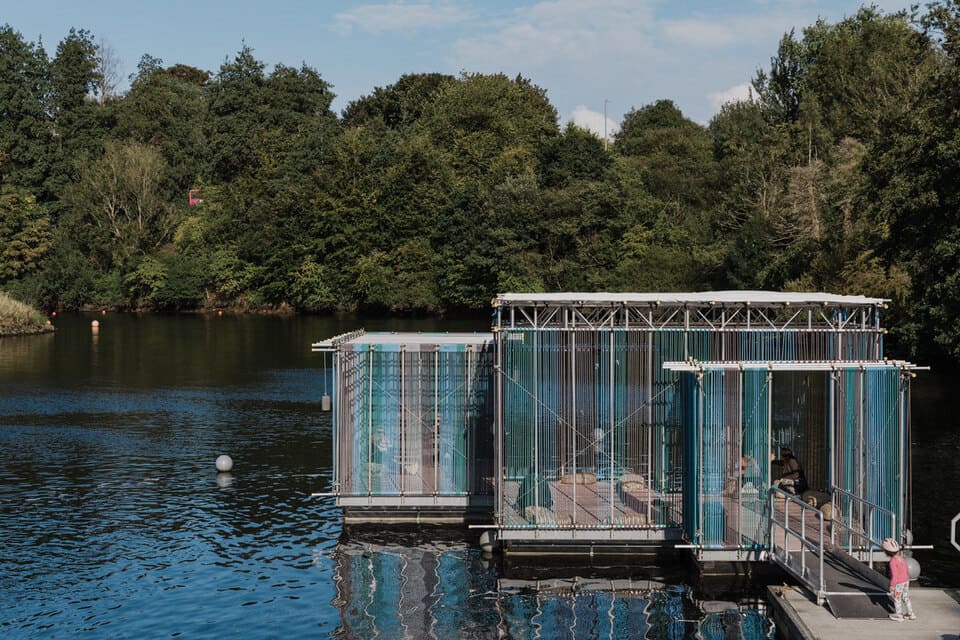
As a project, DRIFT brings together engineering, fabrication, sound art and urban place-making in a remarkably coherent way. Its floating form and changing configurations allow it to respond to different sites, while its material strategy ensures that this flexibility does not come at the expense of durability.
The pavilion shows how a modest palette of well-coordinated parts can generate a rich civic experience. More importantly, it demonstrates how hot dip galvanizing can support architecture that is not only adaptable and demountable, but also capable of delivering long term protection in a demanding waterside context.
On the River Lagan, DRIFT offers a compelling example of what floating public space can become: reusable, low-impact, and closely attuned to both people and place.
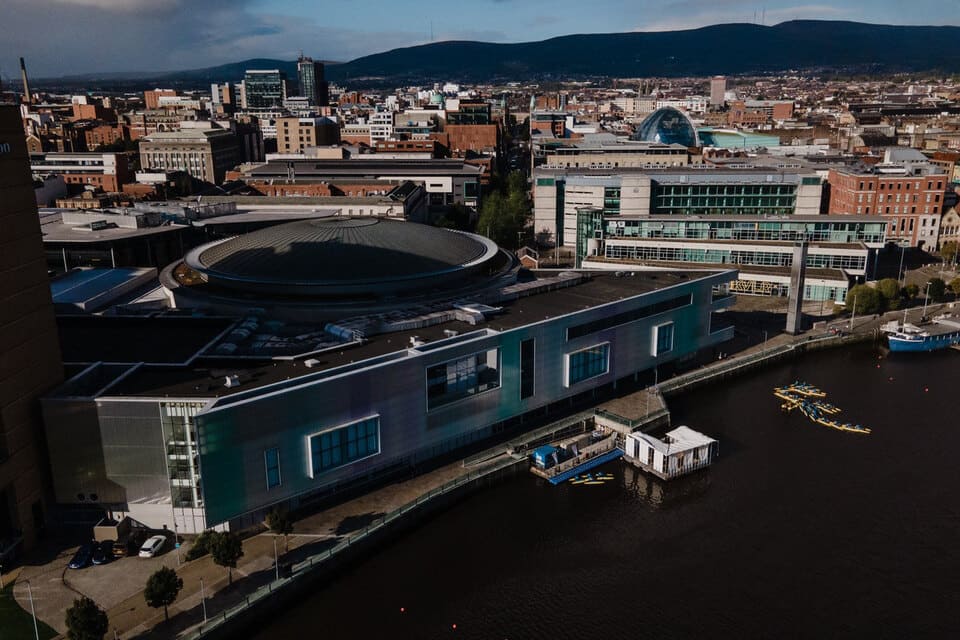
Project Information
OGU Architects
© Joe Laverty / Elyse Kennedy /Dominic Coyle / OGU
- UK & Ireland
- Clevedon, England
- UK & Ireland
- UK & Ireland
- Bochum, Germany
- Putbus, Germany
- Inverkip, Scotland
- Rhineland, Germany
- Belfast, Northern Ireland
- London